
Cape of Good Hope Triangular Stamps
The world's first and most famous triangular stamps, issued by the Cape of Good Hope in 1853. The triangular shape was designed to help illiterate postal workers distinguish prepaid letters without reading them.
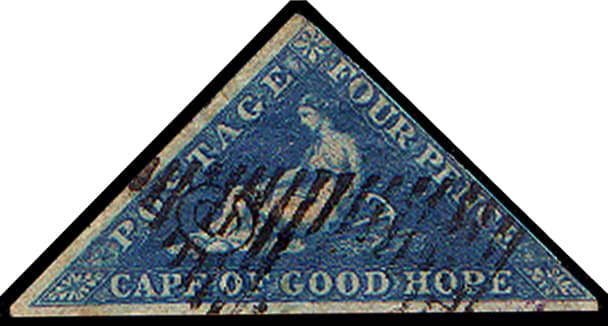
Cape of Good Hope (now South Africa) · 1853
Cape of Good Hope Triangular Stamps
Overview
The Cape of Good Hope Triangular stamps hold a unique place in philatelic history as the world's first triangular postage stamps. Issued in September 1853 by the British colony of the Cape of Good Hope (now part of South Africa), they were designed in an unusual triangular shape specifically to help illiterate postal workers distinguish prepaid letters (bearing a stamp) from unpaid ones at a glance. The design was created by Charles Bell, the Surveyor General of the Cape Colony, and featured the allegorical seated figure of 'Hope' with an anchor — the Cape Colony's symbol. The stamps were engraved and printed by Perkins Bacon & Co. in London. Several printings were produced between 1853 and 1864, with significant variation in paper quality, color, and printing technique. The rarest variety is the so-called 'woodblock error' of 1861, when a wooden replacement block was accidentally used with the wrong color: the 1d stamp printed in blue (normally the 4d color) and 4d in red — creating some of the most famous errors in philatelic history.
Design & Technical Details
Equilateral triangle shape. Allegorical seated figure of 'Hope' with an anchor at her side. Inscriptions 'CAPE OF GOOD HOPE' along the top edge and the denomination along the base. Imperforate in early printings; perforated from 1863. Brick-red for the 1d; deep blue for the 4d. The 1861 woodblock errors reversed these colors.
Historical Facts
- Issued September 1, 1853 — the world's first triangular postage stamps
- Triangular shape designed to help illiterate postal sorting workers identify prepaid mail
- Designed by Charles Bell, Surveyor General of the Cape Colony
- Printed by Perkins Bacon & Co., London — the same printers as the Penny Black
- The 1861 'woodblock errors' (1d blue and 4d red) are among the most famous stamp errors
- Multiple printings between 1853 and 1864 with significant color and paper variations
- Replaced by rectangular issues when the Cape joined the Union of South Africa
How to Identify This Stamp
If you believe you may have found a Cape of Good Hope Triangular Stamps, here are key identification characteristics to check:
- The equilateral triangle shape is immediately distinctive — no other major stamp uses this format
- The seated figure of 'Hope' with an anchor is the central design element
- Early issues (1853) are imperforate; look for cut edges with no perforations
- Color variants are significant: 1d should be brick-red, 4d should be blue
- The extremely rare 1861 woodblock errors are reversed: 1d blue, 4d red
- Multiple printings make identification complex — specialist catalogs like SG are essential
Frequently Asked Questions
Why are the Cape of Good Hope stamps triangular?
The triangular shape was a practical design decision to help illiterate postal workers quickly identify prepaid mail without reading. A triangle-shaped stamp on an envelope could be immediately recognized by feel and sight as a prepaid letter — innovative thinking for 1853. The shape also makes the stamps instantly recognizable to collectors today.
What is the Cape of Good Hope woodblock error?
In 1861, the Cape Colony ran out of print plates and had wooden replacement blocks made locally. By mistake, the 1d and 4d blocks were swapped, resulting in the 1d being printed in blue (the 4d color) and the 4d in red (the 1d color). These woodblock errors — with their reversed colors — are among the most famous and valuable stamp errors from British colonial philately.
How much are Cape of Good Hope triangular stamps worth?
Common examples of the Cape triangles start at $50–$200 used in average condition. Fine used examples of the 1853 first printings range from $500–$5,000. Rare varieties and color errors can reach tens of thousands. The woodblock errors are worth $20,000–$100,000+ each, and exceptional examples have sold for over $200,000.