
Blue Mauritius (Post Office Mauritius)
Among the world's most famous stamps, the 'Post Office Mauritius' stamps of 1847 are legendary for bearing the error inscription 'Post Office' instead of 'Post Paid'. Only 27 examples of each value are known.
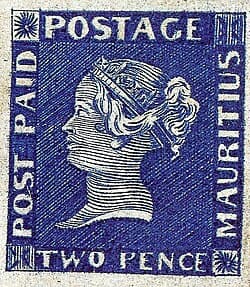
Mauritius · 1847
Blue Mauritius (Post Office Mauritius)
Overview
The Blue Mauritius — officially the 'Post Office Mauritius' stamps — represent one of the great romantic legends of philately. Issued in September 1847 as the first stamps of Mauritius, they were engraved by watchmaker Joseph Osmond Barnard, who inscribed them 'POST OFFICE' where 'POST PAID' was intended. This single engraving error transformed a colonial stamp production into one of the most celebrated mistakes in postal history. The stamps — 500 printed in blue (1 penny) and 500 in orange-red (2 pence) — were used briefly before the error was noticed. Most surviving examples were found on invitations sent by Lady Gomm, the Governor's wife, to a ball she held on September 30, 1847. The stamps on those covers represent the most iconic philatelic items from the British colonial era. Today, fewer than 27 examples of each denomination survive. A pair on cover (one blue, one orange) sold at David Feldman's in 1993 for CHF 5.0 million (approximately $3.85 million), still one of the highest prices ever achieved for a British colonial stamp.
Design & Technical Details
Simple oval design with the profile of Queen Victoria. Inscribed 'POST OFFICE / MAURITIUS' in two lines — the famous 'POST OFFICE' error text. Denomination shown as 'ONE PENNY' (blue) or 'TWO PENCE' (orange-red). No perforations — imperforate. Engraved by hand by local watchmaker Joseph Osmond Barnard.
Historical Facts
- Issued September 21, 1847 — among the earliest stamps issued by a British colony
- Engraved by watchmaker Joseph Osmond Barnard; 'POST OFFICE' error instead of 'POST PAID'
- First stamps famously used on Lady Gomm's ball invitations (September 30, 1847)
- Only 500 each of the blue and orange-red were printed
- First discovered as rarities in 1864 when 15 examples were found in a Paris collection
- In 1904 a schoolboy reportedly sold two examples for a few pennies, unaware of their value
- A pair on cover sold for CHF 5.0 million ($3.85M) in 1993 at David Feldman, Geneva
How to Identify This Stamp
If you believe you may have found a Blue Mauritius (Post Office Mauritius), here are key identification characteristics to check:
- Look for 'POST OFFICE' (not 'POST PAID') — this is the defining error
- Imperforate — no perforations on any authentic example
- Hand-engraved appearance; less crisp than machine-printed stamps
- Blue for 1d, orange-red for 2d — color is distinctive but beware of faded examples
- On cover (original envelope) is dramatically more valuable than a loose stamp
- Expert authentication is mandatory — forgeries and fakes are well-documented
Frequently Asked Questions
What makes the Blue Mauritius so famous?
The Blue Mauritius is famous for three reasons: its age (1847, among the world's earliest stamps), its scarcity (fewer than 27 known for each value), and the romantic story of the 'POST OFFICE' error. The legend of Lady Gomm's ball invitations and the dramatic history of their discovery have made them symbols of the romance of stamp collecting.
How much is the Blue Mauritius worth?
Individual examples of the Blue Mauritius (1d or 2d) are worth approximately $1–2 million each. A pair on cover sold for $3.85 million in 1993. Given appreciation in top-tier philatelic markets since then, a pair today would likely exceed $5 million. The stamps rarely appear at auction, making precise current valuation difficult.
What is the 'Post Office' error on the Mauritius stamps?
The engraver, Joseph Osmond Barnard, inscribed 'POST OFFICE' on the stamp dies instead of the intended 'POST PAID'. This was likely a misunderstanding of the design specifications. The error was caught after 500 of each denomination were printed — and since the stamps were already in use, they couldn't be recalled. This single word error transformed ordinary colonial stamps into legendary philatelic treasures.