
Hawaiian Missionaries
Some of the rarest and most sought-after stamps in the world, issued by the Kingdom of Hawaii in 1851 for use by missionaries. The 2¢ value is particularly rare, with fewer than 20 known examples.
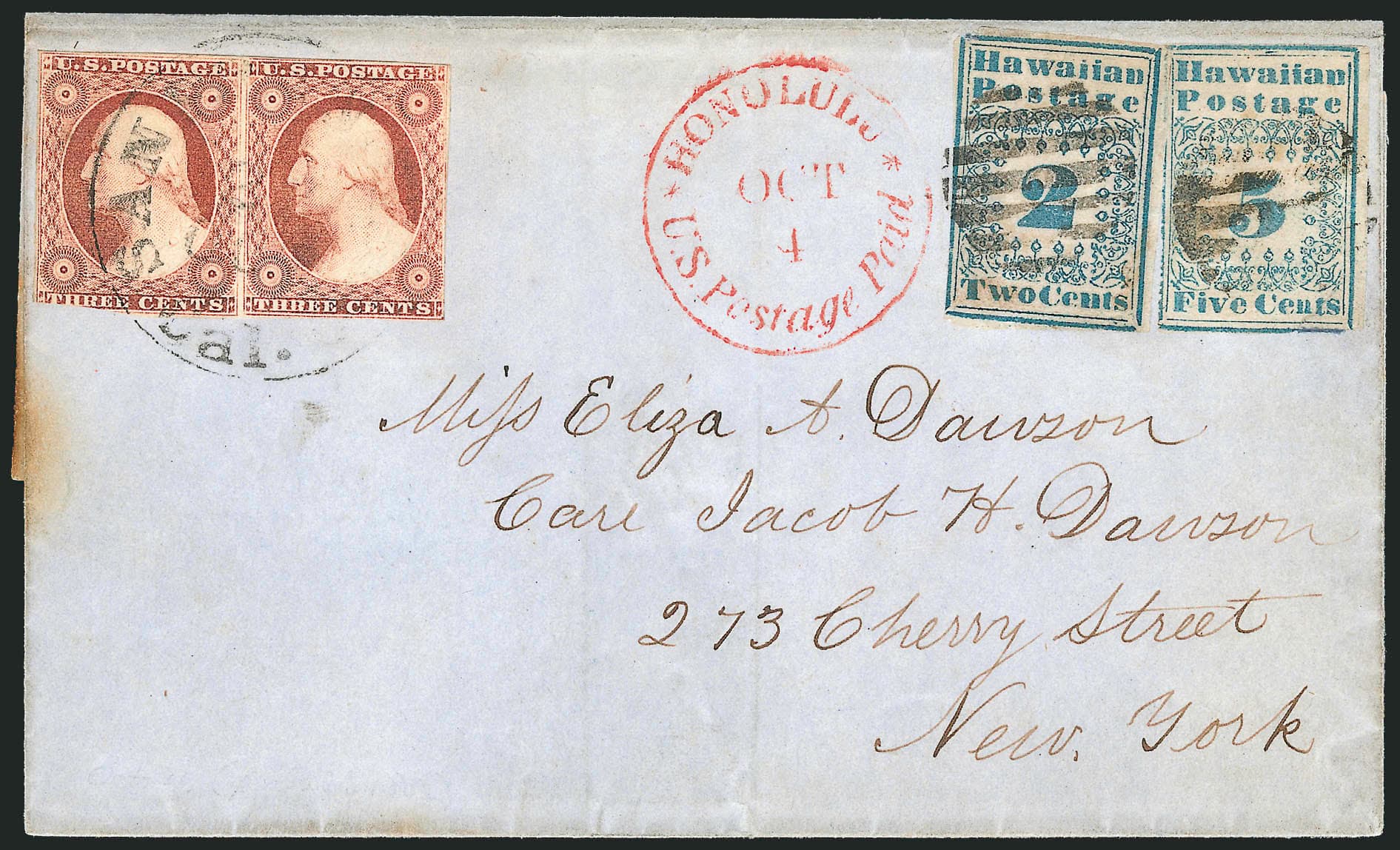
United States (Kingdom of Hawaii) · 1851
Hawaiian Missionaries
Overview
The Hawaiian Missionary stamps hold a unique place in philatelic history as both the first stamps issued in Hawaii and some of the rarest in the world. Issued in 1851 by the Kingdom of Hawaii, they were nicknamed 'Missionaries' because the majority of surviving examples were found on correspondence sent by American missionaries stationed in Hawaii. The stamps were printed locally on very thin, fragile paper using a simple typeset design — which partly explains their scarcity, as the paper deteriorated easily. Three denominations were issued: 2¢, 5¢, and 13¢. The 2¢ stamp is by far the rarest, used on local letters within the islands. A notorious chapter in the stamps' history involves French collector Gaston Leroux, who was murdered in 1892 in Paris by a fellow collector who coveted his 2¢ Hawaiian Missionary — one of the most dramatic crimes ever committed over a stamp. Today, the stamps are considered among the most prized in all of philately, especially on original missionary correspondence.
Design & Technical Details
Simple typeset design printed in blue ink (2¢ and 5¢) and orange-yellow (13¢). Text reads 'H.I. & U.S. POSTAGE' (Hawaiian Islands and United States) with the denomination. No illustrations — just typography. Printed on extremely thin, fragile paper. Imperforate — cut by scissors from sheets.
Historical Facts
- Issued in 1851 by the Kingdom of Hawaii — the first official Hawaiian stamps
- 'Missionaries' nickname comes from American missionaries being the primary correspondents
- A French collector was murdered in 1892 for his 2¢ Hawaiian Missionary stamp
- Printed on very thin paper, making well-preserved examples extremely scarce
- Hawaii did not join the US postal system until after annexation in 1898
- The 2¢ stamp was used for local inter-island postage; fewer than 20 known examples survive
- Three denominations: 2¢ (rarest), 5¢, and 13¢ (for trans-Pacific mail to the US)
How to Identify This Stamp
If you believe you may have found a Hawaiian Missionaries, here are key identification characteristics to check:
- Extremely thin paper — much thinner than standard stamps; fragile to handle
- All authentic examples are imperforate (no perforations)
- Blue ink for 2¢ and 5¢; orange-yellow for 13¢
- Simple typeset 'H.I. & U.S. POSTAGE' text with denomination — no illustrations
- Most valuable on original missionary covers (envelopes); loose stamps are worth significantly less
- Expert authentication from the Philatelic Foundation essential for any claimed example
Frequently Asked Questions
What are the Hawaiian Missionary stamps?
The Hawaiian Missionary stamps are a set of primitive typeset stamps issued by the Kingdom of Hawaii in 1851 in three denominations: 2¢, 5¢, and 13¢. They were the first official postage stamps issued in Hawaii. They are nicknamed 'Missionaries' because they are most often found on letters written by American missionaries working in Hawaii during the 1850s.
How much are Hawaiian Missionary stamps worth?
Values vary dramatically by denomination and condition. The 2¢ blue (rarest) in used condition typically sells for $50,000–$250,000 or more. A 2¢ on cover sold for $2 million at Robert A. Siegel in 2020. The 5¢ and 13¢ are valuable but more attainable, ranging from $10,000 to $100,000+ depending on condition.
Why was a collector murdered over a Hawaiian Missionary stamp?
In 1892, French collector Hector Girard murdered fellow collector Gaston Leroux in Paris to steal his prized 2¢ Hawaiian Missionary stamp. The stamp was never recovered. Girard was caught and sentenced to life imprisonment. The incident shocked the philatelic community and became one of the most notorious crimes in stamp collecting history.